Unpacking the True Meaning of Surrealism in Art
meaning of surrealism in art

Unpacking the True Meaning of Surrealism in Art

Dive deep into the revolutionary art movement that reshaped perception and challenged reality.

Explore Surrealism Now

Key Takeaways

  • ✓ Surrealism emerged from Dadaism in the 1920s.
  • ✓ André Breton authored the first Surrealist Manifesto in 1924.
  • ✓ It sought to unleash the power of the unconscious mind.
  • ✓ Key techniques included automatism, dream analysis, and juxtaposition.

How It Works

1
Understand the Precursors

Surrealism didn't appear in a vacuum; it evolved from Dada's anti-art sentiments and psychoanalytic theories. Grasping these roots is crucial for context.

2
Explore Core Principles

Delve into the movement's foundational ideas like psychic automatism, the role of dreams, and the rejection of rational thought. This unlocks its philosophical core.

3
Analyze Key Artworks

Study iconic pieces by Dali, Magritte, Ernst, and others to see these principles in action. Observe how they manipulate reality and evoke subconscious narratives.

4
Recognize Its Enduring Legacy

Understand how Surrealism influenced not just art, but also literature, film, fashion, and even psychology. Its impact resonates widely even today.

The Birth of a Revolution: Defining Surrealism's Origins
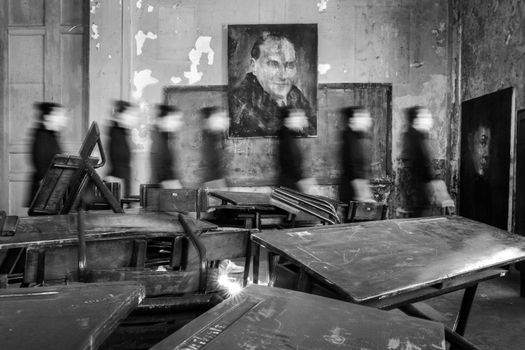
Blurry figures move in a dilapidated room with striking portraits and overturned tables. Photo: Soner Arkan / Pexels
To truly grasp the meaning of surrealism in art, one must first journey back to its tumultuous origins in the aftermath of World War I. Emerging from the ashes of Dadaism, a nihilistic art movement that questioned all established norms, Surrealism sought not to destroy, but to rebuild – on the foundations of the unconscious mind. Spearheaded by the poet André Breton, who published his seminal 'Manifesto of Surrealism' in 1924, the movement declared its allegiance to the revolutionary insights of Sigmund Freud. Freud's theories on dreams, the subconscious, and the liberating power of repressed desires provided the intellectual bedrock for a generation of artists and writers disillusioned with rationalism and societal conventions that had led to global conflict. Breton, alongside figures like Louis Aragon and Philippe Soupault, initially explored automatic writing, a technique designed to bypass conscious thought and tap directly into the subconscious stream. This literary experimentation soon translated into visual arts, with artists like Max Ernst, Joan Miró, and later Salvador Dalí, developing their own visual languages to express these profound psychological states. They believed that by merging the dream world with the waking world, they could create a 'surreality' – a higher reality that transcended conventional logic and perception. This wasn't merely about depicting strange or fantastical scenes; it was a deeply philosophical and psychological quest to liberate the human spirit from the constraints of reason and societal conditioning. The movement was characterized by its radical approach to creativity, advocating for an uninhibited exploration of desire, fear, and the irrational. It challenged the very definition of what art could be, proposing that the most profound truths lay hidden beneath the surface of everyday life. Understanding these formative years is crucial to appreciating the depth and radical intent behind the meaning of surrealism in art, marking it as far more than just a style, but a profound way of seeing the world and the self. Learn more about art movements and their impact.

Unlocking the Subconscious: Core Principles and Techniques
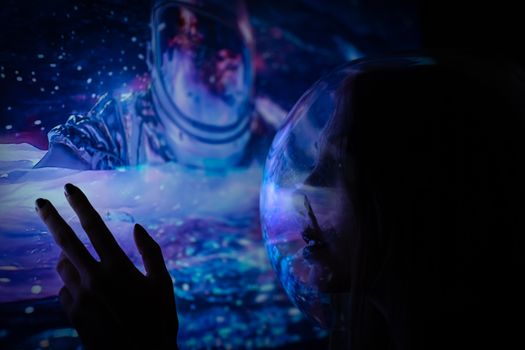
A hand touches a cosmic image of an astronaut with ethereal reflections, evoking imagination. Photo: Connor Scott McManus / Pexels
At the heart of the meaning of surrealism in art lies a profound commitment to unlocking the subconscious mind. Surrealists were fascinated by the world of dreams, hypnosis, and automatic processes, believing these offered a direct conduit to deeper truths often obscured by conscious thought. Psychic automatism, a technique derived from automatic writing, became a cornerstone. Artists would attempt to create without conscious control, allowing their hands to move freely, or their minds to wander, in an effort to bypass rational intervention. This could manifest as spontaneous drawing, painting, or sculpting, resulting in imagery that felt both familiar and utterly alien. Another fundamental principle was the powerful juxtaposition of incongruous objects. Think of René Magritte's famous pipe, inscribed with 'Ceci n'est pas une pipe' (This is not a pipe), or Salvador Dalí's melting clocks. By placing unrelated items together in unexpected settings, Surrealists aimed to shock the viewer, disrupt conventional understanding, and provoke new insights. This 'convulsive beauty,' as Breton termed it, sought to reveal the hidden connections and poetic possibilities within the mundane. They were less interested in creating beautiful images in a traditional sense, and more in creating images that were psychologically resonant, unsettling, or profoundly thought-provoking. The use of symbolism, often personal and deeply rooted in the artist's own psyche, was also prevalent. While some symbols might be universally recognizable, many were highly individual, inviting viewers to engage in their own interpretation and psychological exploration. Dream analysis played a significant role, with many artists drawing directly from their nocturnal visions or employing dream logic in their compositions. The irrational, the illogical, and the fantastical were not merely decorative elements but essential tools for plumbing the depths of human experience. This emphasis on the inner world, on the subjective and the often-unsettling aspects of the psyche, distinguishes Surrealism from earlier art movements. It wasn't about depicting reality as it appeared, but about depicting the 'reality' of the mind, a reality often more vibrant, terrifying, and profound than anything found in the waking world.

Iconic Figures and Their Diverse Interpretations of Surrealism
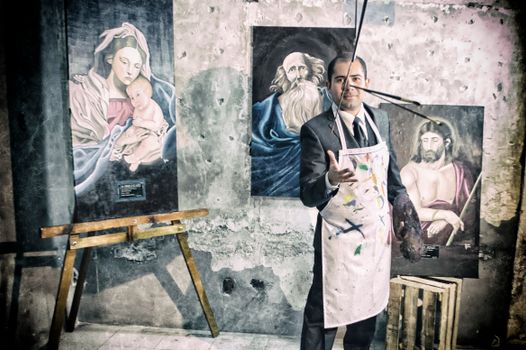
Artist in a suit and apron poses with Renaissance-style paintings in an old studio. Photo: Genaro Servín / Pexels
The meaning of surrealism in art is vividly illustrated through the diverse practices of its most iconic figures. While united by core principles, each artist brought a unique vision and technique to the movement. Salvador Dalí, perhaps the most recognizable Surrealist, became synonymous with his meticulously rendered, hyper-realistic dreamscapes, famously described as 'hand-painted dream photographs.' His works, such as 'The Persistence of Memory' (1931) with its melting clocks, or 'Swans Reflecting Elephants' (1937), are prime examples of his paranoiac-critical method, where he deliberately cultivated hallucinatory states to access subconscious imagery. His technical mastery allowed him to present the utterly bizarre with convincing clarity, making the irrational seem disturbingly real. René Magritte, on the other hand, approached Surrealism with a more philosophical and intellectual bent. His paintings often question the nature of representation, language, and reality itself. Works like 'The Treachery of Images' (1929), with its image of a pipe and the caption 'Ceci n'est pas une pipe,' challenged viewers to consider the relationship between an object and its depiction. Magritte's style was often more deadpan and enigmatic, creating a sense of quiet disturbance rather than Dalí's theatrical flamboyance. His precise, almost academic style made the incongruities in his work all the more startling. Joan Miró offered a more abstract and lyrical interpretation of Surrealism. While his early work was more representational, he soon developed a unique visual language of biomorphic forms, vibrant colors, and childlike spontaneity. Works like 'The Tilled Field' (1923-24) or 'Harlequin's Carnival' (1924-25) evoke a playful, often cosmic, dream world, reflecting his interest in automatism and the innocence of the subconscious. Max Ernst, a pioneer of Dadaism and Surrealism, was a master of innovative techniques like frottage (rubbing) and grattage (scraping), which allowed chance and unconscious impulses to guide his compositions. His intricate, often disturbing, collages and paintings reveal a dark, fantastical imagination. Explore more about famous artists and their groundbreaking contributions. These varied approaches highlight that Surrealism was not a monolithic style, but a rich and expansive intellectual and artistic endeavor, constantly pushing the boundaries of perception and expression.

Beyond the Canvas: The Enduring Legacy and Misconceptions of Surrealism
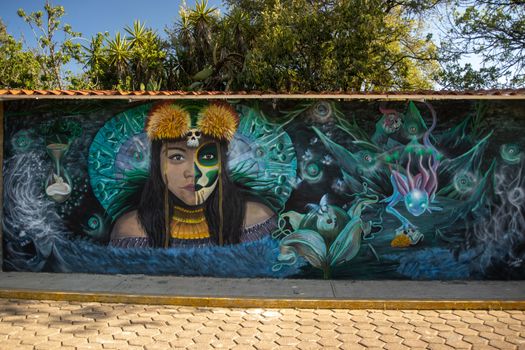
Colorful street art mural blending human and natural motifs on an outdoor wall. Photo: Fausto Hernández / Pexels
The meaning of surrealism in art extends far beyond the specific paintings and sculptures created during its heyday. Its influence permeated various cultural spheres, fundamentally altering how we perceive creativity and the subconscious. In literature, writers like William S. Burroughs and Gabriel García Márquez borrowed Surrealist techniques, creating narratives steeped in dream logic and magical realism. Filmmakers, from Luis Buñuel (who collaborated with Dalí on 'Un Chien Andalou') to David Lynch, have embraced Surrealism's disruption of linear narrative and exploration of the subconscious. Fashion, advertising, and even psychology have felt its indelible mark, demonstrating its profound cultural reach. However, there are common misconceptions about Surrealism. Many mistakenly equate it simply with 'weird' or 'fantastical' imagery. While it certainly produced such visuals, its core was a serious philosophical and psychological inquiry, not merely an aesthetic choice. It wasn't about creating random, shocking images for the sake of it, but about revealing deeper truths through the juxtaposition of the rational and irrational. Another misconception is that it was purely a visual art movement. As discussed, it began with poetry and literature, and its tenets were applied across various creative disciplines. Furthermore, some believe Surrealism was solely about individual expression. While personal subconscious exploration was key, the movement also had a strong political and revolutionary undercurrent, often aligning with communist ideals and challenging bourgeois society. Tips for appreciating Surrealism: 1. **Look Beyond the Surface:** Don't just see strange objects; ask what psychological or philosophical idea the artist might be exploring. 2. **Embrace Ambiguity:** Surrealism often provides no single 'correct' interpretation. Allow yourself to engage with the work on an emotional and intuitive level. 3. **Consider the Context:** Remember its origins in post-WWI disillusionment and Freudian psychology. 4. **Explore Different Artists:** Each Surrealist has a distinct voice. Discovering the breadth of styles will deepen your understanding. 5. **Read the Manifestos:** André Breton's writings offer direct insight into the movement's intentions.

Comparison

FeatureSurrealismCubismImpressionism
Primary FocusUnconscious mind, dreamsGeometric forms, multiple perspectivesLight, atmosphere, fleeting moments
Key TechniquesAutomatism, juxtapositionFragmentation, simultaneityBrushstrokes, color theory
Relationship to RealityTransforms/subverts realityDeconstructs realityCaptures sensory reality
Emotional ImpactDisturbing, poetic, dreamlikeIntellectual, analyticalCalm, vibrant, evocative
Founding FiguresBreton, Dalí, MagrittePicasso, BraqueMonet, Renoir

What Readers Say

"This article brilliantly explains the true meaning of surrealism in art. I always thought it was just weird paintings, but now I understand its deep psychological and philosophical roots. It's incredibly insightful."

Eleanor Vance · Brooklyn, NY

"As an art history student, I found this breakdown of surrealism's core principles and techniques invaluable. The distinctions between artists like Dalí and Magritte were particularly well-articulated, clarifying so much for me."

Marcus Chen · Los Angeles, CA

"Before reading this, I struggled to grasp the meaning of surrealism in art beyond its surface-level strangeness. Now, I feel a genuine connection to the artists' intentions and can appreciate the works on a much deeper level."

Sarah Jenkins · Austin, TX

"A very comprehensive guide to surrealism. While I wish there were a few more examples of lesser-known artists, the coverage of the main figures and the movement's philosophy is excellent and very well-researched."

David Miller · Chicago, IL

"I'm a designer, and understanding the meaning of surrealism in art has directly inspired my creative process. The concepts of juxtaposition and tapping into the unconscious are powerful tools for innovation."

Priya Sharma · Seattle, WA

Frequently Asked Questions

What is the primary goal of Surrealism in art?

The primary goal of Surrealism is to resolve the previously contradictory conditions of dream and reality into an absolute reality, a surreality. It seeks to liberate the creative potential of the unconscious mind, often through the juxtaposition of unexpected imagery and the exploration of dream logic, to challenge rational thought and societal norms.

Is Surrealism just about making weird or strange art?

No, Surrealism is far more than just creating strange or weird art. While it often employs unusual or fantastical imagery, this is a means to a deeper end: to explore the subconscious, challenge conventional perceptions of reality, and reveal hidden truths. The 'strangeness' is purposeful, aimed at provoking thought and accessing deeper psychological states.

How can I identify a Surrealist artwork?

You can often identify Surrealist artwork by its dreamlike quality, illogical juxtapositions of objects, distorted or fantastical figures, and a sense of unsettling beauty. Look for themes of the unconscious, sexuality, and desire, often rendered with meticulous detail or, conversely, through automatic, spontaneous techniques.

Was Surrealism a political movement?

Yes, Surrealism had strong political undertones. Many Surrealists were aligned with communist or anarchist ideologies, believing that the liberation of the mind was intertwined with social and political liberation. They often critiqued bourgeois society, colonialism, and the rationalism they felt led to war and oppression.

How does Surrealism differ from Dadaism?

Surrealism emerged from Dadaism but differed significantly. Dadaism was largely nihilistic, reacting to the horrors of WWI by rejecting all logic and meaning. Surrealism, while inheriting Dada's anti-establishment spirit, sought to build something new – a 'surreality' – by exploring the unconscious, rather than simply destroying existing conventions.

Who should explore the meaning of surrealism in art?

Anyone interested in understanding the deeper currents of modern art, psychology, philosophy, or creative expression should explore the meaning of surrealism in art. It's particularly appealing to artists, writers, designers, and thinkers who seek to push boundaries and explore the hidden depths of the human experience.

Is Surrealism still relevant today?

Absolutely. Surrealism's influence is still widely seen in contemporary art, film, advertising, fashion, and literature. Its emphasis on the subconscious, dreams, and the power of irrational thought continues to resonate in a world grappling with complex realities and seeking new forms of expression beyond pure logic.

What impact did Freud have on Surrealism?

Sigmund Freud's theories on the unconscious mind, dreams, and psychoanalysis had a monumental impact on Surrealism. André Breton and other Surrealists were deeply influenced by Freud's ideas that dreams were a 'royal road to the unconscious,' providing a framework for their exploration of automatic writing, dream imagery, and the liberation of repressed desires in art.

Delve deeper into the captivating world of Surrealism. By understanding the profound meaning of surrealism in art, you unlock a new lens through which to view creativity, psychology, and the boundless possibilities of the human imagination. Start your exploration today.

Topics: meaning of surrealism in artsurrealism definitionsurrealist movementsurrealist artistsart movements
Leo List

DK Escorts LU Escorts AT Escorts SE Escorts FI Escorts CH Escorts DE Escorts HR Escorts IE Escorts GR Escorts CZ Escorts NO Escorts BE Escorts FR Escorts SI Escorts IL Escorts NL Escorts PL Escorts HU Escorts ES Escorts IT Escorts PT Escorts SK Escorts RO Escorts ZA Escorts UY Escorts US Escorts UK Escorts NZ Escorts AU Escorts
Brampton weed
Adultwork EstrelaBet Vai de Bet R7 Bet Betão Galera Bet Rainbet Bet9ja Shop SportyBet BetKing Sisal Loto Foot Hollywoodbets YesPlay Odibets RushBet Jugabet BetWarrior BetCity MSport betPawa Fortebet